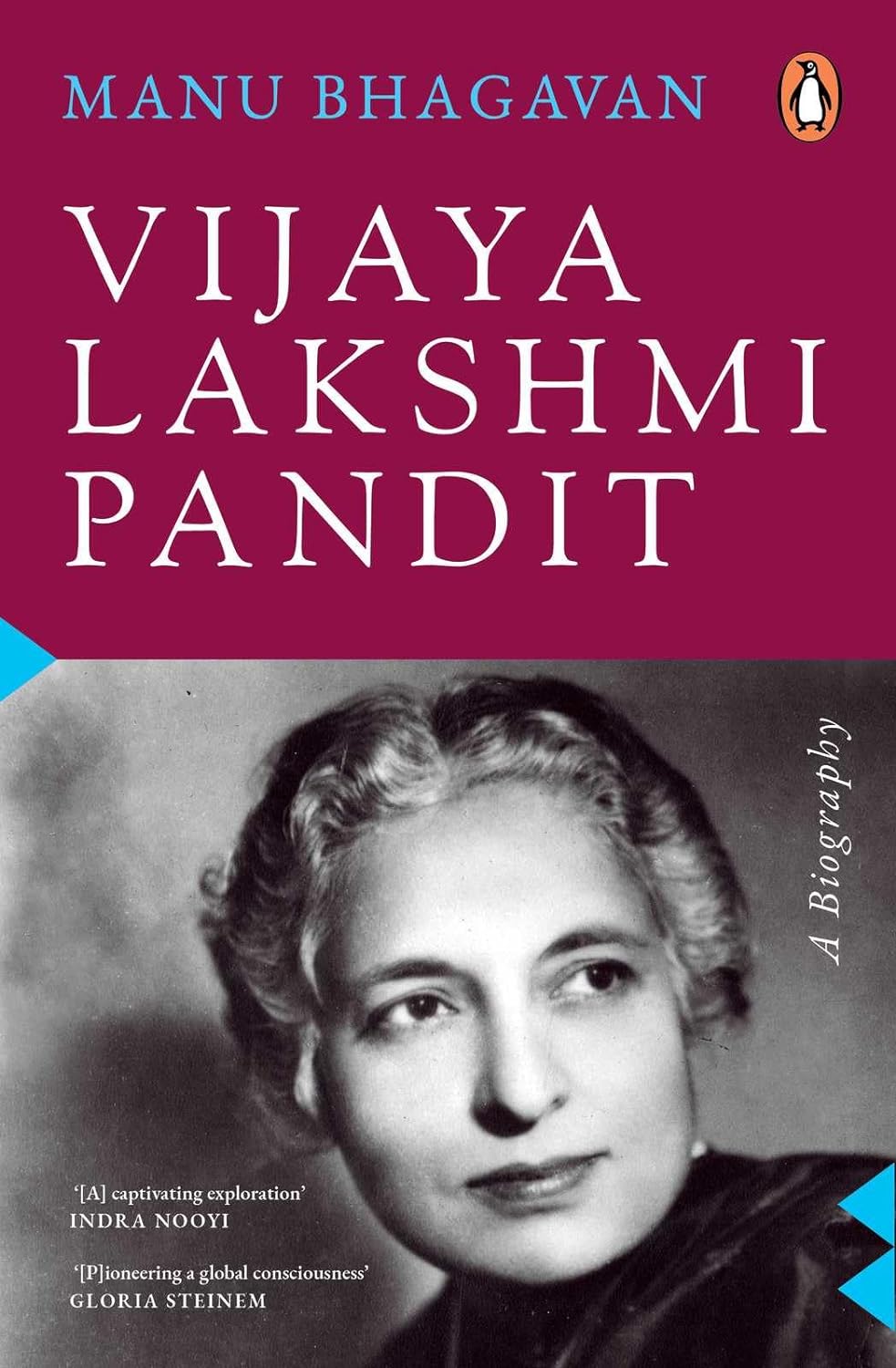
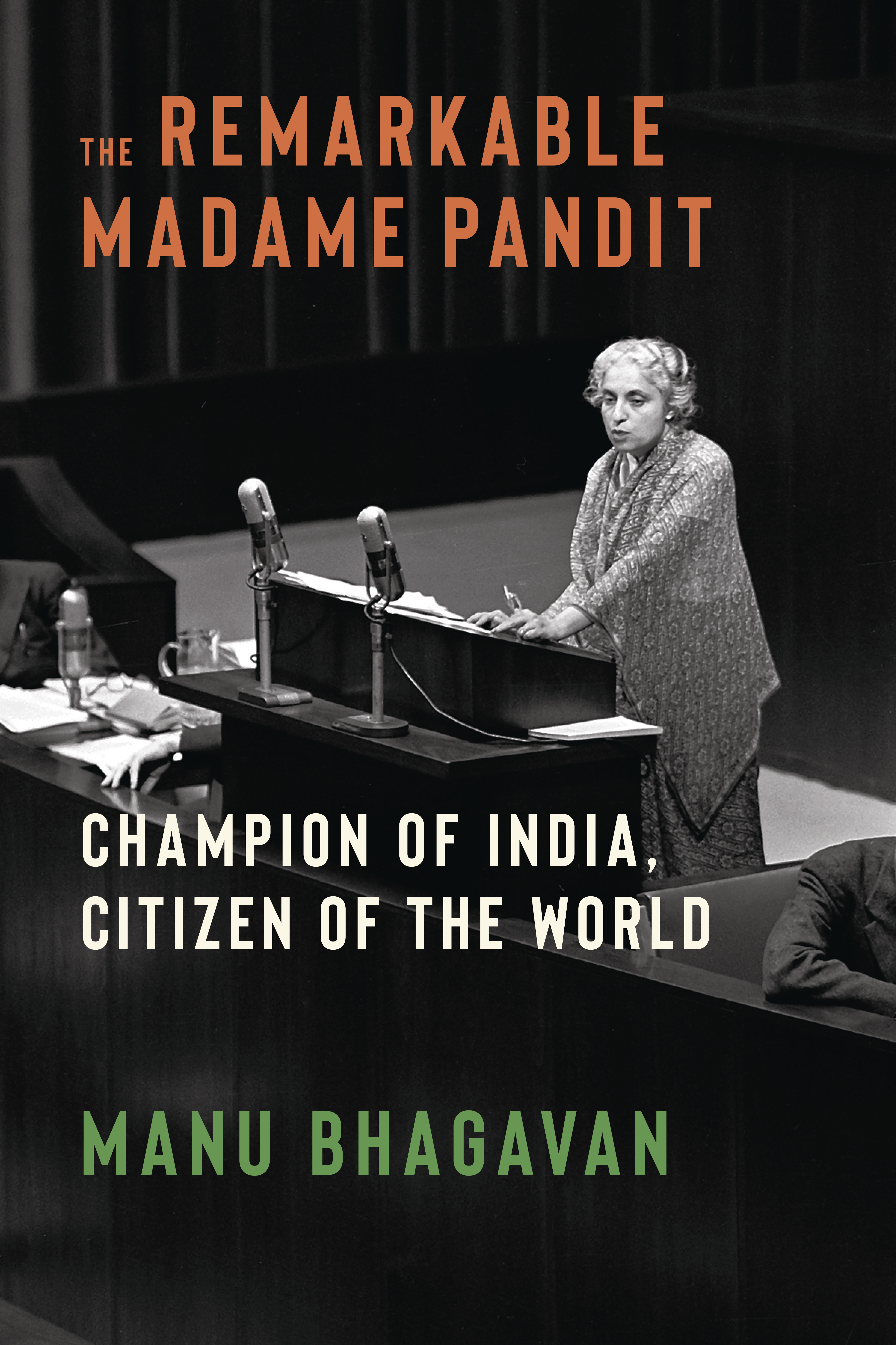
A pioneering politician and diplomat, Vijaya Lakshmi Pandit (1900–1990) was an Indian icon, admired worldwide for her brilliance and glamour. Eleanor Roosevelt called her “the most remarkable woman” she had ever met. Madame Pandit, as she was widely known, moved in elite global circles even as she worked to improve the lives of millions. She traded quips with Winston Churchill, worked alongside Albert Einstein, and was detained for the attempted assassination of Benito Mussolini. She even came out of retirement to campaign against her own niece, Indira Gandhi, to stop an authoritarian takeover and save Indian democracy.
The Remarkable Madame Pandit is the definitive biography of India’s greatest modern diplomat. Manu Bhagavan chronicles Pandit’s life and times, from her upbringing in an illustrious family to her role in her country’s fight for independence and through to her globe-trotting career bridging East and West. Pandit was India’s first woman cabinet minister, an ambassador to the United States and the Soviet Union, and the first woman elected president of the UN General Assembly. Her influence extended well beyond these formal roles: she became one of the most prominent international voices for peace while paving the way for women in many fields. Based on eight years of research using material in five languages from seven countries, this book tells Madame Pandit’s gripping story in full—and, in so doing, retells the history of India and the world in the twentieth century.
“[An] exhaustive biography…[A] magnum opus”— Dr. Reba Som, The Indian Journal of Gender Studies.
“Brilliant”— Nikhil Sanjay-Rekha Adsule, Live Law.
“[D]oes full justice to an extraordinary life and is likely to become a definitive reference work on recent history”— Journal of the Commonwealth Lawyers’ Association.
“Wonderfully written…. Manu Bhagavan has lived up to his scholarly reputation”— Arvindar Singh, The AIDEM.
“A masterpiece”–David White, Director of Advocacy and Communications, Coalition for Disaster Resilient Infrastructure. Read more on Twitter/X.
“Magisterial”–The Coffee House Experience podcast, 19 September 2024. Listen to the whole broadcast here.
The #3 nonfiction bestseller in India, Asian Age, 7 January 2024
Top 5 (unranked) nonfiction bestseller for January 2024, The Bookworm.
Nonfiction bestseller, Kolkata airport, 5 January 2024
The #4 airport bestseller, WHSmith, Indira Gandhi International Airport, New Delhi, 2 January 2024
“Long before everything from COVID to air travel had proved our unity on Spaceship Earth, Vijaya Lakshmi Pandit was pioneering a global consciousness. It’s high time you met her. — Gloria Steinem, writer and activist
Sidelined by the “great men” school of history writing, Vijaya Lakshmi Pandit is brought to life in this vividly written and painstakingly researched biography. You’ll find yourself eagerly turning the pages to learn what happens next in a story you thought you already knew. — Daisy Rockwell, International Booker Prize-winning translator of Tomb of Sand
With this illuminating biography, Manu Bhagavan restores Vijaya Lakshmi Pandit to the pantheon of extraordinary individuals who created a modern India according to their noble vision of international human rights. Written in lucid prose with a scholar’s unflinching eye, this is yet a deeply affectionate portrait of a complex woman, and a masterful recreation of a thrilling period in history. — Kiran Desai, Booker-prize winning author of The Inheritance of Loss
Vijaya Lakshmi Pandit is not merely a biography; it is a captivating exploration of a life that shattered barriers and challenged conventions. Manu Bhagavan skilfully honours Pandit’s legacy, inviting us to re-evaluate history through a new lens and inspiring us to envision a more inclusive, just and interconnected world — Indra Nooyi, former chairman and CEO of PepsiCo
Rigorously researched and engagingly written, Manu Bhagavan’s Vijaya Lakshmi Pandit: A Biography presents a highly readable portrait of one of India’s earliest, and perhaps, most influential women diplomats. By adroitly highlighting her sterling contributions in defining the paradigms that anchored Indian foreign policy post-Independence, Bhagavan has crafted a much-needed intervention into the debates over the evolution of our place in the world — Shashi Tharoor, MP
Vijaya Lakshmi Pandit’s extraordinary and eventful life is the story of India and its women, of the international order, and of Indian foreign policy, at a very consequential time in the twentieth century. Her life was a series of firsts and innovations: India’s first woman cabinet minister, president of the UN General Assembly, ambassador to Moscow and Washington, India’s leading voice abroad in the first decade after Independence―her list of firsts is longer than I can mention here. Her contributions to building the post-World War II order were acknowledged internationally. And her social conscience led her to pioneer much that we now take for granted. This remarkable lady has finally found a fitting biographer in Manu Bhagavan, whose historical sensibility and rigour is on full display in this sensitive and objective biography, which is also a contribution to intellectual history. I could not put it down until I had read it through. — Shivshankar Menon, former national security adviser of India
Vijaya Lakshmi Pandit has tragically been a footnote in narratives of Indian history and its foreign policy in the twentieth century. Most would recognize the name, but few are aware that hers was among the most recognizable Indian faces―and compelling voices―in the post-World War II years. Through meticulous research across continents, and with a steady, sober pen, Manu Bhagavan restores this remarkable woman to the centre of our attention. A feminist, politician, diplomat, anti-colonial activist, and above all, an individual of tremendous spirit and dynamism of character, Vijaya Lakshmi Pandit at last receives here the biography she deserves. — Manu S. Pillai, author of False Allies: India’s Maharajahs in the Age of Ravi Varma
This is the first, full-length biography of Vijaya Lakshmi Pandit―pioneering politician and diplomat, whose life tracked the arc of India’s history in the twentieth century. In a thoroughly researched and readable account, Manu Bhagavan sets her private and public selves firmly in the context of tumultuous events in India and the wider world — Srinath Raghavan, author of The Most Dangerous Place: A History of the United States in South Asia
In his meticulously researched, readable, sensitive and formidable biography, Manu Bhagavan has captured the life and times of this remarkable historical figure, a twentieth-century woman of integrity, passion and principle — David Nasaw, Arthur M. Schlesinger Professor of History Emeritus, CUNY Graduate Center, and author of The Last Million: Europe’s Displaced Persons from World War to Cold War
This is a deeply researched, well-judged and riveting biography. It rescues Vijaya Lakshmi Pandit from the shadow of Nehru and turns the spotlight on her achievements. In doing so, it provides a cinematic account of a wide-ranging figure whose deep imprint was felt on the national movement, the world of arts and letters, modern diplomacy, and even the muted but remarkable psychodramas of the Nehru family. The grace of narrative matches the grace of its subject — Pratap Bhanu Mehta, former vice-chancellor of Ashoka University
Watch an interview on the multi-Emmy Award-winning show UrbanU on CUNY TV:
Watch an interview on the Caravaka podcast, 1 April 2024:
Listen to a conversation with Ellen Chesler on the International Horizons podcast on the New Books Network, 18 March 2024.
“‘A fair amount of detective work’: How Manu Bhagavan Wrote Vijaya Lakshmi Pandit’s Biography,” Scroll.in, 16 March 2024.
Watch an interview with Sagarika Kissu on The Print #SoftCover :
Watch an interview with Daanish Bin Nabi, 5 February 2024:
“How Vijaya Lakshmi Pandit Played Peacemaker between Palestine and Israel,” The Hindustan Times, 16 January 2024. Picked up and republished in The Mainstream Weekly, 19 January 2024.
Read a profile from Hunter College here.
“When Vijaya Lakshmi Pandit was picked up by police for attempted assassination of Mussolini.” Read an excerpt on The Print.
‘She’s Almost a Ghost’. Read coverage of the December 2023 discussion of the book at the India International Centre, New Delhi here.
Watch a 30-minute feature interview with renowned journalist Barkha Dutt:



This collection of essays inverts the way we see the Cold War by looking at the conflict from the perspective of the so-called developing world, rather than of the superpowers, through the birth and first decades of India’s life as a postcolonial nation. Contributors draw on a wide array of new material, from recently opened archival sources to literature and film, and meld approaches from diplomatic history to development studies to explain the choices India made and to frame decisions by its policy makers. Together, the essays demonstrate how India became a powerful symbol of decolonization and an advocate of non-alignment, disarmament, and global governance as it stood between the United States and the Soviet Union, actively fostering dialogue and attempting to forge friendships without entering into formal alliances. Sweeping in its scope yet nuanced in its analysis, this is the authoritative account of India and the Cold War.
Contributors: Priya Chacko, Anton Harder, Syed Akbar Hyder, Raminder Kaur, Rohan Mukherjee, Swapna Kona Nayudu, Pallavi Raghavan, Srinath Raghavan, Rahul Sagar, and Waheguru Pal Singh Sidhu.
Named a “Book of the Week” and heralded as “definitive” by FirstPost.
Ranked #5 on The Curious Reader’s list of August 2019 “excellent and must-read nonfiction.”
“7 Lesser Known Facts about India’s Role in the Cold War,” on the Penguin Digest.
Read a Twitter thread from Penguin about the book:
Here is an interesting essay by Syed Akbar Hyder on #UrduPoet #Faiz during the #ColdWar from @ManuBhagavan‘s #IndiaAndTheColdWar #FridayFeeling #HappyReading #thread
— Penguin India (@PenguinIndia) September 20, 2019
Read an excerpt on the Penguin Digest.
Read an excerpt in The Print.
Read an excerpt on Rediff.com.
An interview with me on the CUNY Graduate Center website: “Nehru and the Superpowers: India’s Influence in the Cold War.”
“How Nehru and India Helped Keep Peace in the Cold War Era,” SUM CUNY.
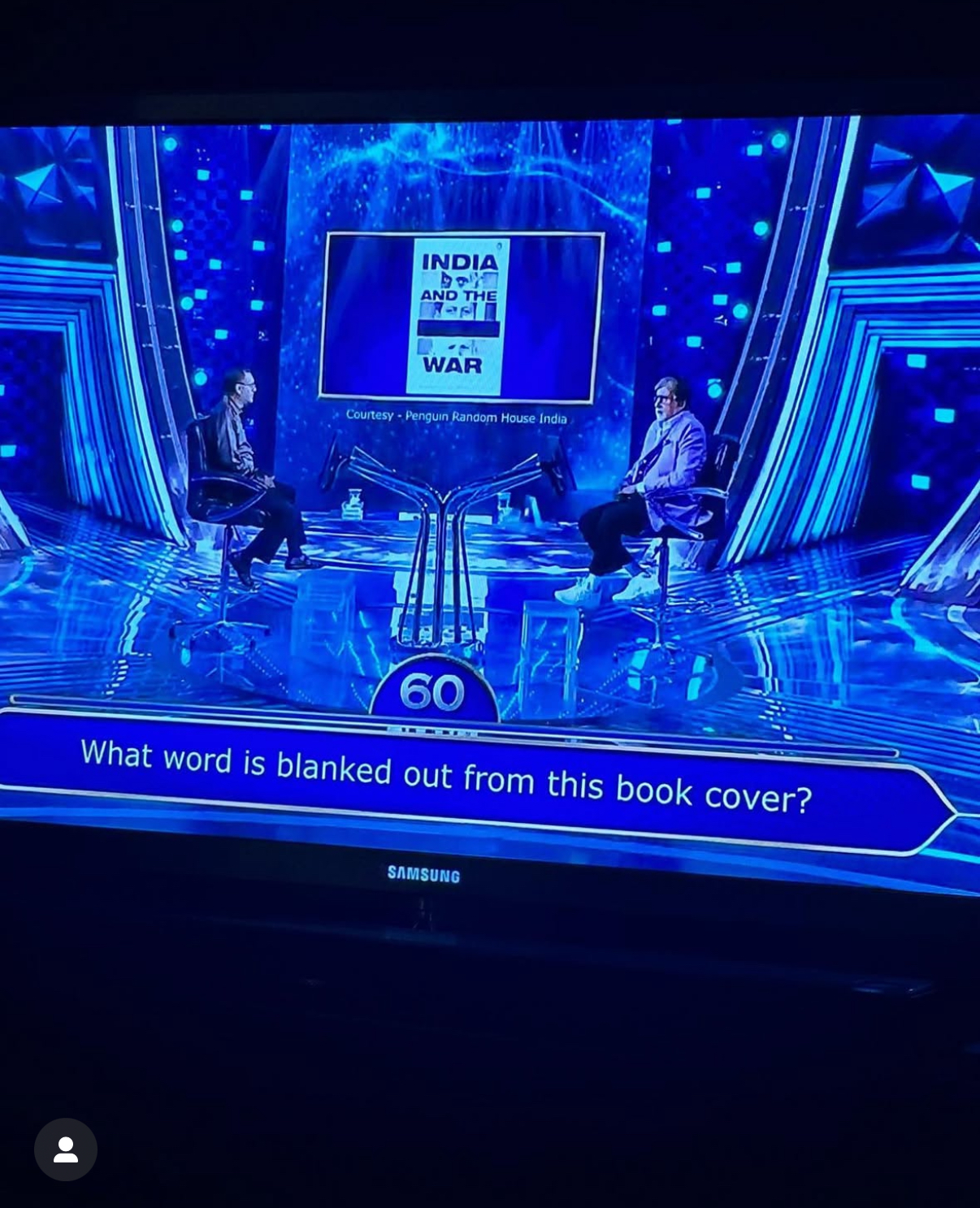
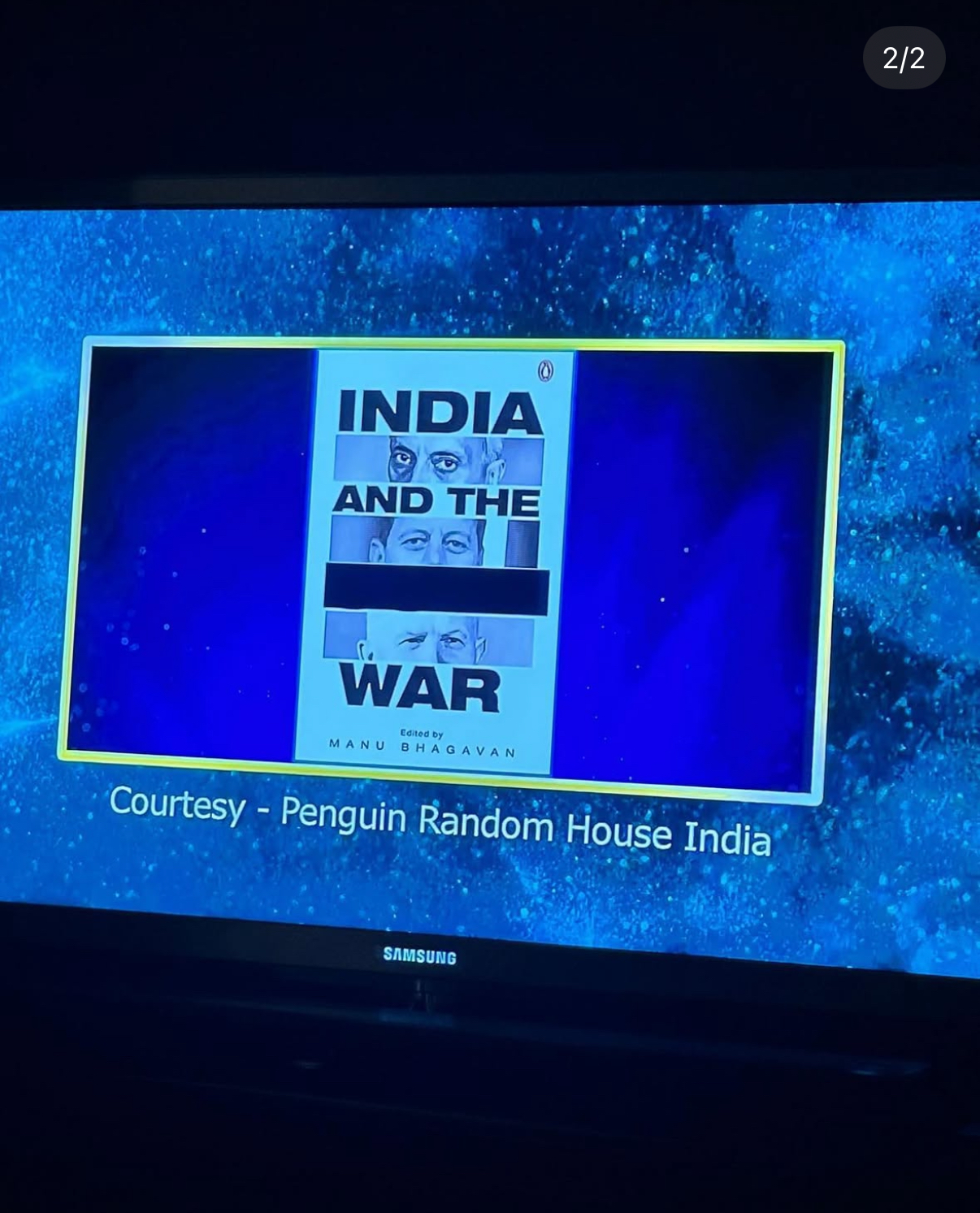
India and the Cold War appeared as a question on Kaun Banega Crorepati (Who Wants to be a Millionaire-Hindi), asked by host Amitabh Bachchan.
“Bhagavan’s India and the Cold War examines independent India and its Cold War history on economic, political, diplomatic, and cultural fronts. What Bhagavan assembles here, like Westad’s The Global Cold War, is itself required reading for a better understanding of the history of modern India as well as a challenge to scholars to reconceive their images of Cold War India…. Bhagavan has assembled ten incredible scholars, of different disciplines and writing on varied research topics, to produce a much-needed work on Indian history…. One hopes this impressive collection will long inspire and generate debate, in much the way Westad’s book continues to, 15 years after its release. Scholars of modern India and Indian foreign relations history should look to Bhagavan and his work for inspiration as they research and write their own accounts of Indian thinking and actions during the Cold War. Manu Bhagavan’s India and the Cold War shows what is possible when scholars break free from older arguments and established narratives to cast a wider lens on a subject, which merits a fresh set of eyes.” –Marc Reyes, in Reviews in History. Read the full review here.
“Manu Bhagavan proved his credentials as an accomplished political historian with his earlier work, The Peacemakers, on India’s active and influential diplomatic role in the early years after its independence. His considerable and pioneering research pointed to a hitherto unacknowledged role that India played in the negotiation of international norms on a number of key issues despite being outside the league of major powers. India’s non-alignment gave it the credentials to play the go-between in the emerging polarisation of the Cold War…. The current volume, India and the Cold War, takes that story further, providing greater detail and more nuanced perspectives, putting together contributions from several well-known analysts, who have drawn on more recently available archival material.” –Ambassador Shyam Saran, former Foreign Secretary of India and Senior Fellow, the Centre for Policy Research, in the Business Standard. Read the full review here.
“Bhagavan’s ‘inverted’ Indian account shows India was a wily ‘swing’ state keen to exploit opportunities afforded by an unpropitious geopolitical climate. The chapters, read together, indicate officials were aware of the space India had to manoeuvre and deployed a mix of tactics—moral, realist and ideological—to improve national security, eschew conflict, advance alternative development paths and support global causes like decolonisation, peacekeeping and human rights.” –Karthik Nachiappan in Open the Magazine. Read the full review here.
“This book presents a compelling and fascinating narrative of diplomacy and power politics against the backdrop of the early and middle Cold War years, of peacemaking and economic development, and of the cultural terrain that transgressed political boundaries. The formulation and deployment of India’s foreign policy options against the pull and push of globally competing ideological forces are delineated in detail. The grim realities of international power politics confronting a new Republic facing formidable challenges of territorial consolidation and economic underdevelopment are vividly recalled. The play of ‘virtuous purpose’ and pragmatic national interest in the theater of conflict, disarmament, and competing models of economic development is probed in depth. This is a book that enlightens and explains. It is a gripping story of independent India’s historic coming into the modern world.”–Nirupama Rao, former foreign secretary and ambassador of India to China and to the United States
“Exploring the richness and complexity of India’s Cold War experience, this volume is essential reading for those who wish to understand how we got where we are and India’s present choices. These fascinating essays broaden our understanding of India’s foreign policy and the Cold War itself. They also foretell a brighter future for the study of international relations in and about India.”–Shivshankar Menon, former National Security Advisor to the Prime Minister of India
“This collection of fine essays on how India navigated the Cold War and sought to protect national interests in these tense decades following her Independence has not only great scholarship value but also contemporary significance. The noted authors blend deep archival research with incisive commentary making the anthology eminently readable and appealing not just to academics but to the larger public as well.”—Jairam Ramesh, member of Parliament, author and former union minister
“Manu Bhagavan and his cohort unpack the rich complexity of India’s international relations during the Cold War and rescue us from the dominant but simplistic understanding of India’s foreign policy during the first decades after Independence.”—C. Raja Mohan, senior journalist, founding director of Carnegie India and director, Institute of South Asian Studies, National University of Singapore
Given India’s rapidly growing importance on the international stage, there is obvious need to understand the historical origins of its worldview, the goals that have driven its actions, and its sense of constraints and opportunities. This work fulfills that need, presented accessibly and with close attention to craft and detail.–Sunil Khilnani, King’s India Institute, London
Featuring well-established scholars, as well as a range of younger voices who are making a significant mark, this is a path-breaking volume that brings together essays on global history, geopolitics, political economy, and culture.–Kanti Bajpai, National University of Singapore
This collection delivers even more than the title suggests. It gathers together a new generation of scholars from around the globe to explore India’s place in the Cold War world, from poetry to summitry and from the optimism of the 1940s to the Emergency of the 1970s–and beyond. Full of insight and information, it is essential reading for anyone interested in Indian foreign relations.–David Engerman, author of The Price of Aid: The Economic Cold War in India
The essays in this volume examine ‘hidden histories’ related to gender, religion, and reform in modern South Asia. Chapters from an array of eminent contributors examine Indo-Muslim cultures and political mobilization, literary aesthetics, and education, broadly defined. Dedicated to Gail Minault, a pioneering scholar of women’s history, Islamic reformation, and Urdu literature, this volume raises new questions about the role of identity in politics and public life, about memory and historical archives, and about innovative approaches to envisioning egalitarianism. It showcases interdisciplinary methodologies. Timely and thought provoking, this book will interest all who wish to understand how our diverse and plural pasts have informed our cosmopolitan present as we struggle to arrive at a better future for all.
Contributors: Amber Abbas, Ishrat Afreen, Asiya Alam, Shahzad Bashir, Aarti Bhalodia, Max Bruce, Julie E. Hughes, Imran Khan, David Lelyveld, Barbara Metcalf, A. Azfar Moin, C.M. Naim, Leah Renold, Francis Robinson, & Sylvia Vatuk
“This diverse collection is a deservedly rich tribute to a scholar who has left her mark on many areas of scholarship on Indian Muslims and Urdu, women and education, and on the many subjectivities formed as a consequence”–S. Akbar Zaidi, Columbia University, H-Asia Reviews
“This collection of outstanding essays covers a range of inter-related subjects concerning modern South Asia, from identity to gender reform, in the context of political transformation. An indispensable contribution for the new voices and fresh perspectives it introduces.” —Ali Asani, Professor of Indo-Muslim and Islamic Religion and Cultures, Harvard University
Hidden Histories powerfully defines and celebrates a field that has refused to be occluded by majoritarian currents. This book contains compelling essays by many of the major figures of the last generation of Urdu Studies and modern South Asian history, by pre-eminent figures of the contemporary moment, and by a number of accomplished next-generation scholars. In addressing the ways in which Urdu literary sensibility has been enmeshed in debates about social reform and politics, Hidden Histories enacts the confluence of Urdu Studies and South Asian history as a promise to unfolding futures, conjuring the notion of history itself, in the words of one contributor, as a “Valley of Enchantment.” —Kamala Visweswaran, Professor of Ethnic Studies, University of California @ San Diego


The Peacemakers is the gripping story of India’s quest to create a common destiny for all people across the world based on the concept of ‘human rights’. In the years leading up to its independence from Great Britain, and more than a decade after, in a world torn asunder by unchecked colonial expansions and two world wars, Jawaharlal Nehru had a radical vision: bridging the ideological differences of the East and West, healing the growing rift between capitalist and communist, and creating ‘One World’ that would be free of empire, exploitation and war.
Madame Vijaya Lakshmi Pandit, Nehru’s sister, would lead the fight in and through the United Nations to turn all this into a reality. An electric orator and outstanding diplomat, she travelled across continents speaking in the voice of the oppressed and garnering support for her cause. The aim was to lay the foundation for global governance that would check uncontrolled state power, address the question of minorities and migrant peoples, and put an end to endemic poverty. Mahatma Gandhi’s legacy would go global. All that stood between the Indians and success was their own fallibility, diplomatic intrigue, and the blinding haze of mistrust and overwhelming fear engendered by the Cold War.
As Manu Bhagavan recounts the story of this quest, iconic figures are seen through new eyes as they challenge all of us to imagine a better future. Based on seven years of research, across three continents, and written in a crisp and riveting style, this is the first truly international history of newly independent India.
“Splendid” —The Speaking Tree/The Times of India * “Hugely engrossing” –CIPOD Realists Blog
“A must read” —Strategic Affairs * “Stunning” —The Book Review
“Fascinating”–Law and Other Things Blog * “Brilliantly researched” –IANS/The Hindustan Times
“Meticulously researched and lucidly written” —Mail Today * “Priceless” —Afternoon Despatch and Courier
“Excellent scholarly analysis…an essential read” —The American Historical Review
“Brilliantly researched and vividly written…. As we contemplate this moment of violent insanity on every continent, alternative paths toward peace in a world united for justice are herein profoundly illuminated”—Blanche Wiesen Cook, author of Eleanor Roosevelt, vols 1–3
“This riveting story recovers one of the most important moments in India’s relationship to the world at large. It captures the extraordinary passion with which a remarkable group of men and women dared to dream of “One World” founded on justice. It vividly describes how this high idealism was matched by an equally adroit political rhetoric that catapulted India to moral leadership. The book combines dramatic flair with rigorous and pathbreaking scholarship. It is a must read for anyone interested in India’s role in global affairs”—Pratap Bhanu Mehta, President and Chief Executive, Centre for Policy Research, New Delhi
“In this vividly written page-turner, Manu Bhagavan recovers a moment of extraordinary possibilities … [and] renews the study of how human rights norms were put on paper, with great consequences for their revival today”—Samuel Moyn, author of The Last Utopia: Human Rights in History
“The Peacemakers is a welcome and compelling challenge to sterile consensus about the kind of ideas that guide India’s world view. Bhagavan excavates the record of India’s formative years to reveal the extraordinary internationalism that guided the republic’s founding figures. Universalism and not narrowly constructed Third Worldism, Bhagavan demonstrates in this ground-breaking work, inspired India’s early international engagement. For Gandhi and Nehru, Bhagavan argues, the pursuit of one world and respect for human rights were integral to the construction of democratic India’s concept of sovereignty”—C. Raja Mohan, columnist, The Indian Express
“With narrative verve and meticulous scholarship, Manu Bhagavan tells an important though underappreciated story. He paints a vivid group portrait of the first generation of modern Indian leaders and thinkers, illuminating how they drew from the ideals of their ancient civilization and their victorious struggle for independence the basis for their country’s foreign policy at a pivotal moment in world history”—Strobe Talbott, President, Brookings Institution
“A powerful re-examination of Indian concepts of international affairs during the era of independence. Bhagavan has written an outstanding book, which helps us understand not just India’s foreign policy, but also how concepts of non-alignment and human rights — often created by Indians — pointed to a world beyond the Cold War”—Odd Arne Westad, Author of The Global Cold War and Director of IDEAS at The London School of Economics
“How appealing yet distant this vision is today. Professor Bhagavan shows us a clear roadmap that can be taken again if we only so choose”—Pam Omidyar, Founder and Chair of the Board, Humanity United

This volume investigates the diverse discourses of identity politics that relate the history of nationalism to current concerns and debates. The essays are laid out as a series of three interrelated conversations. Focusing upon the peripheries of modern India-Assam and Jammu and Kashmir-the first explores the ways in which people living on the margins of a homogenizing nation-state critique the centre and carve out different spaces of experience. The next part analyses the works of Mirza Ghalib and epic traditions in south India to delineate the plurality of narrative and consciousness in literary production. The last section interrogates the writings of Muhammad Iqbal and Mahatma Gandhi to shed new light on their ideas of justice and to situate them in the moment of manoeuvre in nationalist discourse in late colonial India. The volume concludes with a discussion of what it means to construct a post-history of communalism. The essays taken together present an engaging account of the multiplicity of historical experiences in India both within and without the discourse of nationalism. This book will interest scholars and students of modern South Asian history, politics, and sociology, particularly those concerned with identity politics and nationalism. It will also be useful for policymakers, activists, and civil society organizations.
Contributors: Yasmin Saikia, Chitralekha Zutshi, Paula Richman, Syed Akbar Hyder, Faisal Devji, Ajay Skaria, & Gyanendra Pandey
“Much that is new and welcome” —The Indian Economic and Social History Review



How are hierarchies constructed? How do they work? How are they resisted? Seeking to recover histories and voices of ‘those from below’, Speaking Truth to Power and its companion, Claiming Power from Below, explore various issues raised by the lived realities of Dalits, a term deployed here broadly to encompass the specifics of the Caste community while simultaneously pointing to solidarities with other marginalized groups. Together the two volumes examine areas like social hierarchy and reform, the role of religion, the idea of resistance, the functionality of the continued use of the term ‘Dalit’, and the scope of current and future Dalit literature.
The first volume focuses on the role of religion-encompassing beliefs, ethics, ritual, devotional literature, Folk culture, popular narratives, and Artistic expression-and its role in the Construction and deconstruction of caste and power in India. In this context, it also examines the hierarchy of gender, in three different religious traditions (Hindu, Muslim, and Catholic Christian) and regions (Bengal, Urban North India, and Tamil Nadu), in modern times. Book I highlights the role of Buddhism in the social and Political life of Dalits, focusing on readings of early Pali texts, conversions to Buddhism in modern times, and Buddhist artistic expression. The book also critically investigates such areas as popular imagery of B.R. Ambedkar and mystical devotionalism.
The second volume investigates a wide variety of issues related to Dalit politics and literature. Underlining the emergence of the Dalit as a new political subject, it brings together pertinent case studies from different regions and sectors—the politics of the Chamars of Uttar Pradesh; the multiple identities of backward-caste Muslims; colonial oppression of peasants in Bombay Presidency; schooling of Dalit women; and the lives and stories of Bangladesh war victims of 1971. The collection also examines B.R. Ambedkar’s alternative vision of economic development and the linkages betweenrace, caste, and discrimination. The last section discusses issues relating to the articulation of resistance in Dalit literature—the role of the Dalit Lekhak Sangh; representations of women in short stories; and the underpinnings of Dalit poetry. The volume also analyses the paradoxes of such cultural politics.
Dedicated to Eleanor Zelliot, a pioneering scholar of Dalit studies, Speaking Truth to Power and Claiming Power from Below explore the lives and creations of Dalits-the oppressed-and seek to reexamine the subaltern question in the subcontinent through a variety of disciplines and academic approaches.
“[In these volumes] the authors have…[highlighted]…facets of the life, culture, and politics of the teased and oppressed…. They deserve congratulations for [a]…publication distinct for the imbedded passion and intellectual depth.” —The Hindu
“Exploring the emergence of the Bhakti tradition in its composite form, construction of iconography, evolution of religious art…has been the need of the hour and [Speaking Truth to Power] amicably fulfills the requirements…a work that would be read across disciplines.” —The Book Review
“[Claiming Power from Below] presents a kaleidoscopic picture of the universe of dalits across time and space…a befitting tribute to [Zelliot’s] work.” —Economic and Political Weekly
“Balanced and complete. The variety of perspectives and approaches, as well as the broad scope of subject matter, reflect the extremely high level of complexity of the issues surrounding caste, class, and power in the Indian subcontinent.” —International Law and Politics

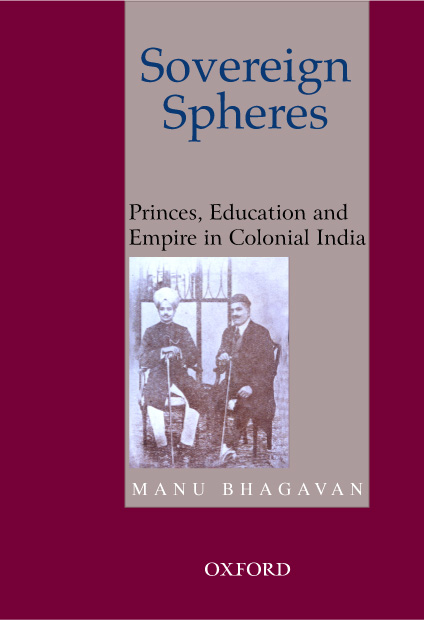
Princely states were semi-autonomous territories that made up roughly 40 per cent of South Asia under British rule. This engaging study looks at educational reform in the context of debates on modernity and anti-colonial nationalism in the two leading progressive princely states in twentieth-century India, Baroda and Mysore.
Sovereign Spheres explores the ways in which colonial authority was challenged and negotiated through both direct political action and more subtle, long-term initiatives involving social and cultural reform. In the process, the book furthers our understanding of domination and resistance and forces us to rethink our notions of the heretofore largely ignored princely states. These regions were central not only to the ideology of empire, but to nationalist visions of postcoloniality as well. In examining the role of princely state universities in the production of modern, governable subjects, the author interrogates the nature of public and private domains in the subcontinent and argues for a fundamental remodeling of colonial India.
Ground-breaking and authoritative, this book will be of importance not just to researchers of South Asian history, but to scholars and students of power dynamics, social reform movements, state formation, and to all those interested in comparative understandings of imperialism, nationalism, and modernity.
“a…radical reinterpretation…. a refreshing take…that, moreover, is quite entertaining to read” –Ian Copland, in The Economic and Political Weekly
“an important contribution…well-researched and clearly written” –Satadru Sen, in Studies in History
“breaks new ground…original work” —The Telegraph
“strikingly creative…a mastery of current scholarship…with well-researched evidence” –Michael H. Fisher, Danforth Professor of History, Oberlin College
“breaks new ground…a welcome addition to historians’ debates on colonial modernity” –Dipesh Chakrabarty, Professor of History and South Asian Studies, University of Chicago

 Manu Bhagavan